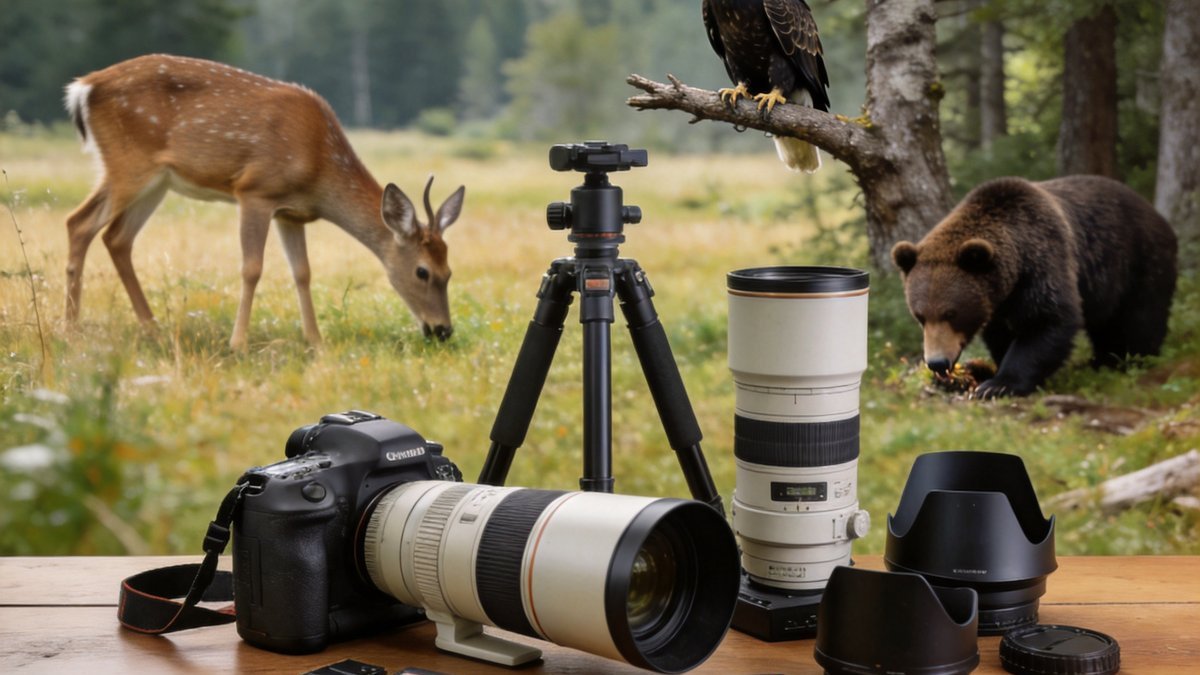
Wildlife photography gear guide covering camera bodies, telephoto lenses, tripods, camera traps, and essential accessories for capturing nature shots.
Choosing the Right Camera Body for Wildlife
Wildlife photography demands specific camera capabilities that differ from landscape or portrait photography. The ideal wildlife camera body balances resolution, autofocus speed, burst rate, and low-light performance. Full-frame sensors offer superior image quality and low-light performance, while crop-sensor bodies provide extra reach with telephoto lenses, an important consideration for distant wildlife subjects.
Mirrorless cameras have largely replaced DSLRs for wildlife photography due to their superior autofocus systems, silent shooting, and electronic viewfinders that show exposure previews. The Sony Alpha series, Canon R-series, and Nikon Z-series all offer excellent wildlife-specific features including animal eye-tracking autofocus that locks onto animal eyes with remarkable accuracy.
Your camera body is important, but the lens matters more for wildlife photography. A mid-range body with a superb lens will produce better wildlife images than a flagship body with an entry-level lens. Invest your budget accordingly.
Telephoto Lenses: The Heart of Wildlife Photography
Telephoto lenses are the most critical equipment for wildlife photographers. Focal length determines how close you appear to your subject. For most wildlife photography, a 400mm to 600mm lens is ideal. Prime lenses offer superior sharpness and wider apertures but cost more and weigh more. Zoom lenses like 100-400mm and 200-600mm offer flexibility at the cost of some image quality.
Aperture affects both image quality and shooting capability in low light. Fast telephoto lenses with f/2.8 or f/4 apertures allow faster shutter speeds in dim conditions and create beautiful background blur but are extremely expensive and heavy. F/5.6 to f/6.3 lenses offer a good balance of performance, weight, and cost for most wildlife photographers.
Tripods and Support Systems
Sharp wildlife images depend on stable camera support, especially with long telephoto lenses. A quality tripod with a gimbal head is the standard setup for wildlife photographers who shoot from fixed positions. Gimbal heads allow the camera and lens to balance perfectly, enabling smooth panning to track moving animals with minimal effort.
For photographers who hike long distances to reach wildlife locations, weight is a critical factor. Carbon fiber tripods offer significant weight savings over aluminum at higher cost. Monopods provide a lightweight alternative that still offers substantial stability improvement over hand-holding. Many wildlife photographers carry both a tripod for stationary shooting and a monopod for mobility.
Camera Traps and Remote Triggers
Camera traps allow wildlife photographers to capture images of shy or nocturnal animals without human presence. A camera trap setup includes a weatherproof camera housing, motion sensor trigger, and typically multiple flash units. The camera is positioned at a location where animals are expected to pass, and the trigger fires the camera when movement is detected.
Modern camera trap systems offer features including adjustable sensitivity zones, time-lapse modes, and infrared triggers that do not spook animals. Some photographers build DIY camera trap setups using Arduino-based triggers. Camera trapping is a specialized field that requires patience, knowledge of animal behavior, and careful ethical consideration of minimal disturbance to wildlife.
Essential Accessories for Wildlife Photography
Beyond the core camera and lens setup, several accessories significantly improve wildlife photography results. A quality camera backpack designed for telephoto lenses protects gear during hikes. Lens cleaning kits are essential since wildlife photography inevitably involves dust, water spray, and mud. Extra memory cards and batteries are non-negotiable for long days in the field.
Camera camouflage including lens covers and camera body wraps helps reduce reflection and blending in with the environment. A beanbag provides an excellent improvised support for shooting from vehicle windows or on the ground. A rain cover for your camera and lens is essential for shooting in wet conditions or near waterfalls and spray zones.
The best wildlife photography gear is the gear you have with you when the moment happens. A smartphone photo of a rare animal beats a professional camera left in the car because the setup was too heavy to carry. Balance ambition with practicality.
In Yellowstone National Park’s Lamar Valley, photographers often stake out positions at dawn near the confluence of the Lamar and Soda Butte rivers, where grizzly bears and wolves frequent the open meadows. A 600mm f/4 prime lens mounted on a Gitzo carbon fiber tripod with a Wimberley WH-200 gimbal head allows for precise tracking of a wolf pack moving across the sagebrush at distances exceeding 300 yards. For those hiking the 12-mile round trip to the summit of Mount Washburn, a lighter setup like a Sony A1 body paired with the 200-600mm f/5.6-6.3 G OSS zoom lens provides the necessary reach without the burden of a heavier prime. The combination of a crop sensor in the Sony A6600 with that same 200-600mm lens yields an effective focal length of 900mm, ideal for capturing pronghorn antelope on the distant plains of Grand Teton National Park.
Effective field craft often dictates the choice between a gimbal and a ball head for wildlife work. The Really Right Stuff PG-02 gimbal head, weighing 2.4 pounds, balances a Canon EOS R3 with a 500mm f/4 lens so perfectly that the photographer can pan smoothly to follow a running coyote across a sagebrush flat at 15 mph. In contrast, a ball head like the Arca-Swiss Monoball P0 is better suited for stationary subjects, such as a great horned owl perched on a fence post along the Snake River at Schwabacher Landing. For low-angle shots of ground-dwelling species like the greater sage-grouse, a compact tripod such as the Gitzo Traveler Series 1 with a short center column allows the camera to be positioned just inches from the ground, reducing the risk of spooking the bird.
Camera traps have become essential for documenting elusive species in remote backcountry locations, such as the cloud forests of Costa Rica's Monteverde Reserve. A setup using a Canon 5D Mark IV body inside an AquaTech housing with a Camtraptions PIR motion sensor can capture the passage of a Baird's tapir along a game trail at night, with the sensor detecting movement up to 30 feet away. For high-altitude work in the Sierra Nevada, a DIY trigger based on an Arduino microcontroller with a passive infrared sensor can be programmed to fire a Nikon D850 and a 24-70mm f/2.8 lens when a mountain lion triggers the beam at a water source. The key to successful camera trapping is positioning the sensor at knee height on the trail, with the camera set to a shutter speed of 1/200 second and an aperture of f/8 to ensure sharp focus across the frame, while using a pair of Nikon SB-910 flash units set to 1/16 power to freeze motion without overexposing the animal’s fur.
For photographers hiking the 8.5-mile out-and-back trail to the summit of Mount Whitney, every ounce of gear must be carefully considered to avoid fatigue at 14,505 feet. A lightweight setup might include a Nikon Z6 II body with the 24-200mm f/4-6.3 VR lens, weighing just 3.2 pounds combined, which is manageable for the 6,100-foot elevation gain. A small tabletop tripod like the Peak Design Travel Tripod at 2.6 pounds provides stability for capturing a pika gathering grass at dawn, while a cotton carrier such as the Cotton Carrier G3 distributes the weight of a heavier lens across the shoulders during the steep ascent. For shooting in the alpine zone above 12,000 feet, a rain cover like the Think Tank Hydrophobia protects the camera from sudden snow squalls and condensation when moving between cold and warm pockets of air.