Table of Contents
Stand-up paddleboarding combines full-body exercise with peaceful water exploration. Learning proper technique transforms the experience from wobbly to effortless.
Jordan Myers
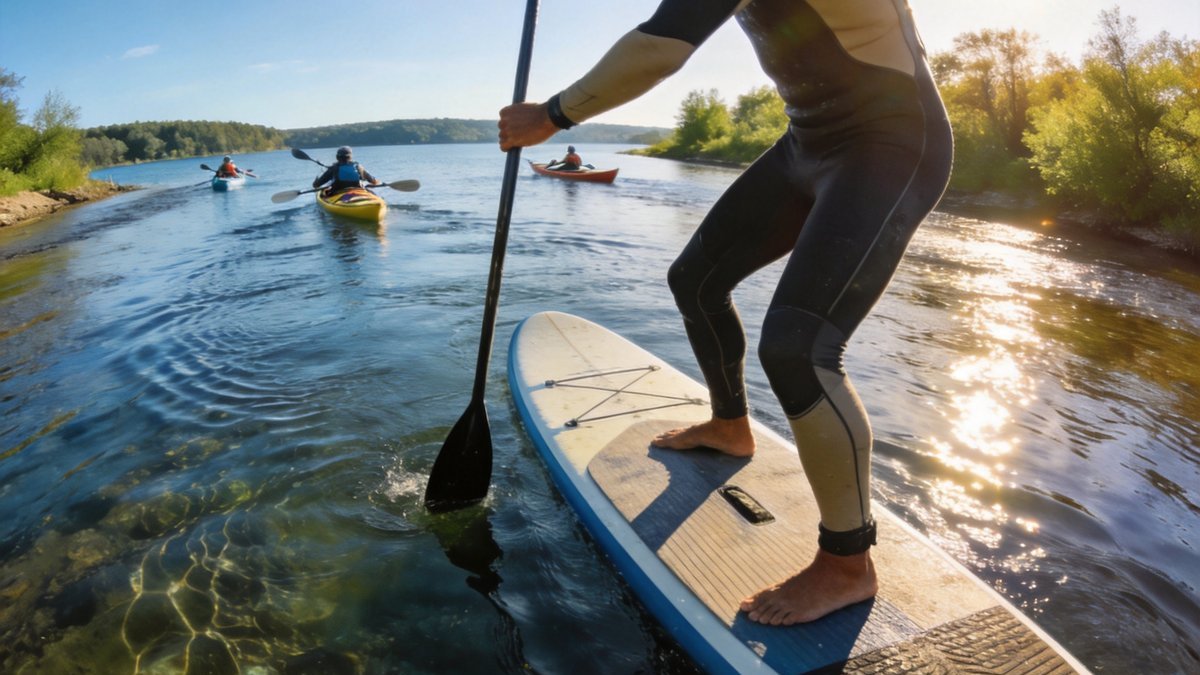
Stand-up paddleboarding combines full-body exercise with peaceful water exploration. Learning proper technique transforms the experience from wobbly to effortless.
Stand-up paddleboarding combines full-body exercise with peaceful water exploration. Learning proper technique transforms the experience from wobbly to effortless.
Stand-up paddleboarding has grown explosively in popularity because it is accessible to nearly anyone with reasonable balance. The basic motion of paddling while standing on a large, stable board feels intuitive after a short practice period. Most beginners can paddle comfortably on calm water within their first session. The learning curve is gentle compared to surfing or whitewater kayaking.
Choose your first SUP session location carefully. Calm, protected waters with no current, minimal wind, and soft bottoms provide the best learning environment. Small lakes, protected bays, and slow-moving rivers are ideal. Avoid areas with boat traffic, strong currents, or wind-exposed conditions for your first several sessions. Morning hours typically offer the calmest water conditions.
Your first SUP board should prioritize stability over performance. Wide boards 32-34 inches wide and 10-12 feet long provide excellent stability for learning. Thicker boards offer more volume and flotation, supporting heavier paddlers and providing a more stable platform. Many rental shops and lesson providers offer beginner-friendly boards designed specifically for first-time paddlers.
Begin paddling on your knees before attempting to stand. Kneel near the center of the board with your knees hip-width apart. Paddle a few strokes from your knees to feel how the board responds to paddle strokes and weight shifts. This kneeling practice builds confidence and helps you understand the board's stability characteristics before committing to standing.
Transitioning to standing requires a smooth, controlled motion. Place your paddle across the board in front of you for stability. Place one foot where your knee was, then the other foot shoulder-width apart. Stand slowly, keeping your weight low and centered. Your feet should be parallel and shoulder-width apart, positioned about 12-18 inches from the centerline of the board.
Proper standing posture prevents fatigue and improves balance. Keep your knees slightly bent to absorb small waves and board movement. Engage your core muscles rather than locking your knees. Look at the horizon rather than down at your feet. Your gaze direction affects your balance significantly. Relax your shoulders and upper body, allowing natural movement with the board.
The SUP paddle is longer than a kayak or canoe paddle. Stand the paddle vertically beside you and reach your arm up. The handle should reach your wrist. This gives you the correct paddle length for most conditions. Adjustable paddles allow you to shorten the paddle for surfing or longer for touring. Experiment with different lengths to find what feels natural.
The forward stroke on a SUP uses torso rotation rather than arm strength. Plant the paddle blade fully in the water near the nose of the board. Rotate your torso as you pull the paddle back along the side of the board. Exit the blade near your feet. Switch sides every 5-10 strokes to maintain straight tracking. A proper forward stroke engages your core and legs, not just your arms and shoulders.
Turning the SUP board requires sweep strokes or back paddling. A forward sweep starts at the nose and arcs wide, turning the board away from the paddle side. A reverse sweep starts at the tail and arcs forward, turning the board toward the paddle side. For tight turns in confined spaces, step back on the board to lift the nose and paddle with wider, more powerful strokes.
SUP boards come in two main constructions: rigid and inflatable. Rigid boards made of epoxy, fiberglass, or carbon fiber offer better performance with stiffer hulls and more efficient gliding. Inflatable boards offer superior portability, storage convenience, and durability against impacts. Inflatable boards have improved significantly in recent years and now perform nearly as well as rigid boards for recreational paddling.
Essential SUP gear includes a leash, PFD, and appropriate clothing. The leash attaches your ankle to the board and prevents separation if you fall. Inflatable SUP boards require a special leash attachment point. A PFD designed for paddle sports provides flotation without restricting movement. Many jurisdictions require PFDs on SUP boards regardless of swimming ability.
SUP fin configuration affects tracking and maneuverability. Single-fin setups are most common and provide good tracking for recreational paddling. Thruster three-fin setups offer better maneuverability for surfing. Removable fin systems allow you to swap fins based on conditions. Take care when launching and landing to avoid damaging the fin box on rocks or the bottom.
SUP opens up unique water exploration opportunities. Gliding silently across the water allows close wildlife encounters that motorized boats cannot approach. Paddleboarding through marshy waterways, along coastlines, and across mountain lakes provides intimate water experiences. The elevated standing position on a SUP offers better visibility than sitting in a kayak or canoe.
SUP touring extends paddleboarding into multi-day adventures. Inflatable touring boards with displacement hulls track efficiently and carry gear for overnight trips. Dry bags strapped to the deck provide waterproof storage. SUP camping combines paddling with lightweight backpacking gear for minimalist adventures. Limit touring distances to 8-12 miles per day for comfortable paddling.
Weather awareness is critical for SUP safety. Wind affects SUP boards significantly due to their large surface area. When wind exceeds 15 miles per hour, paddleboarding becomes difficult and potentially dangerous. Always check the forecast before heading out and plan routes that keep you upwind of your launch point so you can paddle back with the wind if conditions deteriorate.
"The beauty of stand-up paddleboarding is that it transforms any body of water into an adventure. A lake you have driven past a hundred times becomes a new world to explore from the elevated perspective of your board."
"Falling off your SUP is part of the learning process. Every experienced paddleboarder has taken an unexpected swim. The key is to climb back on, adjust your stance, and keep paddling. Each fall teaches you something about balance and board control."
SUP is one of the most accessible water sports. Most beginners can kneel paddle immediately and stand up within their first session. Balance improves quickly with practice. Within three to five sessions, most paddlers feel comfortable in calm conditions. The key is starting in protected waters with appropriate equipment.
SUP uses large muscle groups including core, back, and legs more than arm strength. Proper technique relies on torso rotation and body weight rather than upper body strength. Most people with average fitness can paddleboard comfortably. Sessions of 60-90 minutes provide excellent full-body exercise at a moderate intensity.
Ocean SUP is possible but requires additional skills and awareness. Start in protected bays and harbors before attempting open coast conditions. Learn to read waves, understand tidal currents, and manage surf zone entry and exit. Ankle leashes are essential for ocean SUP. Consider taking a SUP surf lesson if you plan to paddle in coastal environments.
An inflatable SUP board 10-11 feet long and 32-34 inches wide provides the best combination of stability, portability, and durability for beginners. All-around shaped boards with rounded noses and wider tails suit most recreational paddling. Look for boards with at least 200 liters of volume for adequate flotation.
Safety on the water begins before you launch. Always wear a properly fitted personal flotation device, regardless of your swimming ability or water conditions. Check weather forecasts and river flow rates before every trip. File a float plan with someone on shore that includes your route, expected return time, and vehicle details. In cold water conditions, wear appropriate insulation even in warm air temperatures to prevent shock and hypothermia.
Efficient paddling technique reduces fatigue and increases your enjoyment on the water. Engage your core muscles rather than relying solely on arm strength for each stroke. Rotate your torso with each paddle stroke to engage larger muscle groups. Keep your top hand at eye level during forward strokes for optimal leverage. Practice your strokes on flat water before moving to moving water, where good technique becomes essential for safety and control.
Understanding how to read river features keeps you safe and helps you choose the best line through rapids. Look for the V shape where water flows deepest between rocks. Avoid the dark pillow shapes that indicate submerged boulders pushing water upward. Learn to identify eddies behind obstacles where you can rest and scout the next section. In tidal areas, study tide charts and understand how tidal flows affect water levels and current direction throughout the day.